Everything Is 180 Fan
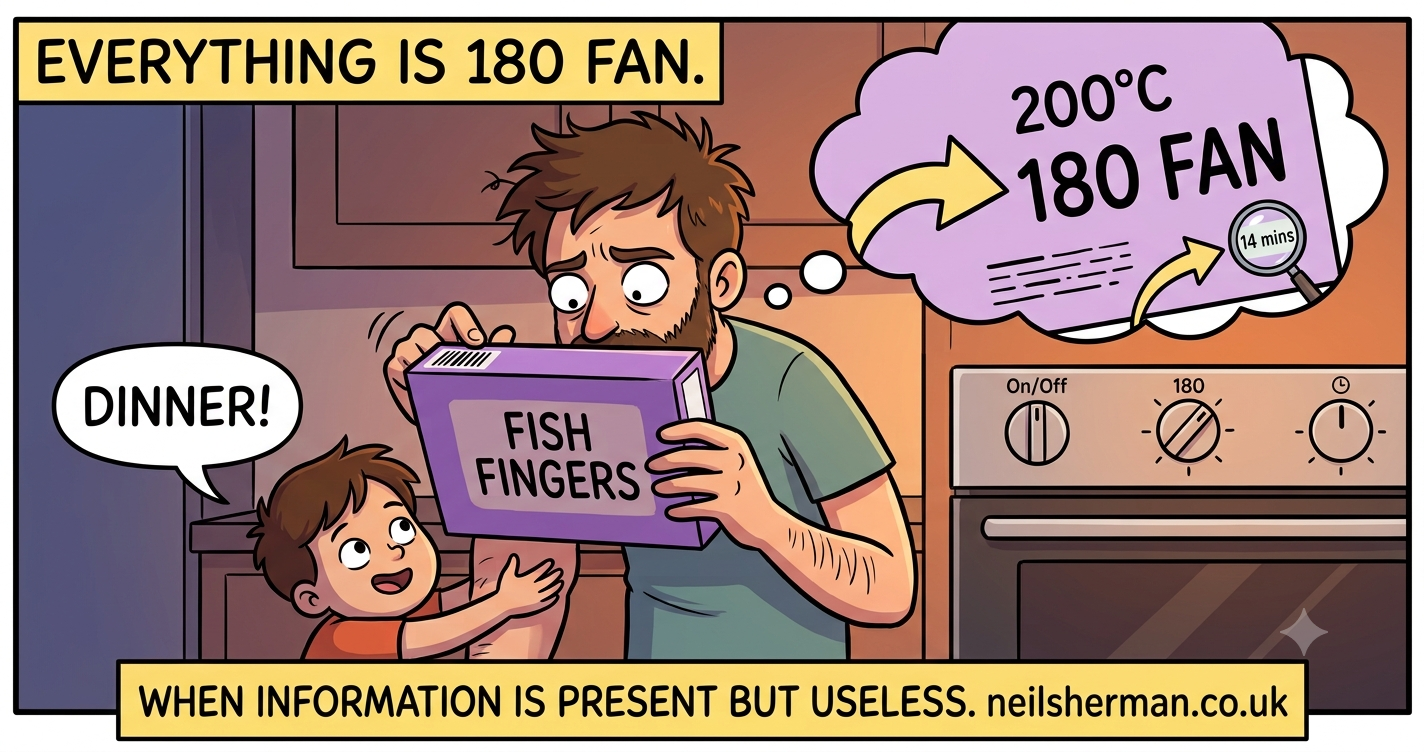
It’s six in the evening. Somewhere behind me a small person is explaining, at volume, that dinner should have happened already and that this is a personal failing of mine. I’ve got a box of oven food in one hand and I’m turning it over, and over, hunting for the one thing I actually need, which is how long the wretched stuff takes to cook.
The temperature I find instantly. It’s printed large, near the top, in bold: 200°C, or 180 fan. I could have told you that without looking. Everything is 180 fan. My oven has three usable settings and two of them are for show. What I came to the box for, the number of minutes, is set in roughly six-point type, tucked between a table of nutritional values and a short paragraph inviting me to recycle the sleeve.
So I stand there, reading glasses somewhere upstairs, holding a box at arm’s length while a three-year-old conducts a one-child protest at my ankles.
My grievance is not that the information is missing. It’s all there. Every time. The box is complete and, I’m sure, legally watertight. The cook time is present. It is also, in the ninety seconds before the protest turns into a sit-in, completely useless to me.
Having the information is not the same as being able to use it. A fact you can’t retrieve at the moment you need it is, for practical purposes, a fact you don’t have.
The box is everywhere
The same shape shows up all over software. An error message that contains the real cause, on line 34 of a sixty-line stack trace, buried under framework noise nobody reads. A log file where the one line that matters is lost in nine thousand lines of INFO cheerfully reporting that everything is fine. A dashboard with forty panels and no opinion about which of them you should be looking at right now. A config file where the three values someone changed are sitting quietly among two hundred defaults nobody has touched since 2019.
In every one of these the information is present. And someone can always point out that it’s present. “It’s in the logs.” “That’s documented.” “The field comes back in the API response.” All true. Each of them, on its own, a polite way of moving the job of finding the thing onto whoever shows up next.
That is the bit I want to argue with. Present gets treated as done, when it’s barely the start of the work.
The loud constant and the quiet variable
There’s a second, sharper version of this hiding in the same oven box, and it’s the temperature.
The temperature is loud because loud is easy. It never changes. The box still lays it out as though I might, this once, go rogue and try 165, so it gets the bold type and the big box, while the number that genuinely varies from one product to the next is left to murmur. Attention is finite, and someone has spent all of mine on the part that was never going to surprise me.
Software does this constantly. The config that prints every default at full volume and gives you no quick way to see the handful of things this particular deployment overrides. The release notes that lovingly re-describe the whole feature when the only question in your head is what changed since Tuesday. If a thing is always true, saying it loudly is not information. It’s decoration.
What the good conjurer does
I do a bit of card magic. Badly, and to a demanding house of two: a five-year-old critic who has seen it all before, and a three-year-old who gasps at absolutely everything, including me dropping the deck, which averages out to roughly fair.
The entire craft is misdirection. You get people to look hard at the hand that doesn’t matter so they never quite look at the hand that does. A decent trick spends the audience’s attention on purpose. Bad information design does the very same thing, only nobody meant to. It points you firmly at the loud, unchanging temperature and lets the number you came for sit off to one side in the dark. There’s no deception in it. There’s just no decision about where you were supposed to look.
Where it stops being a nuisance and starts mattering
The version I feel hardest is a journey plan. Not one departure board, the whole plan: get the 08:12, change somewhere in the middle, arrive by ten.
A plan like that lists every step at the same weight. Walk to the station. Sit on a train for half an hour. Change platforms. Sit on another train. Each line looks like every other line, flat and grey. But I am not losing any sleep over the half-hour sit, and I have done the walk to the station a thousand times. The only part of the whole plan doing anything to my pulse is the change: the seven minutes to get from one platform to another before the doors shut.
That is the number that decides whether the day works. A plan that treats it as calmly as the walk to the station is complete. What it hasn’t done is tell me which line to be frightened of.
On my own I can absorb that and just half-jog to the platform. With a five-year-old asking why we’re running and a three-year-old who has decided this is the ideal moment to stop dead and inspect a drain, the connection stops being a line on the plan and turns into the whole point of the afternoon. It has earned the right to be the loudest thing on the screen. Usually it is buried three taps down with everything else.
The good ones understand this. They mark the change that is genuinely at risk and leave the comfortable steps alone. Done properly, planning a journey means working out which single leg is going to hurt and building the whole thing around making that leg impossible to miss.
That bravery is the hard part, on a journey plan as much as on the back of a box. When something is hard to find, the instinct is to add to it. Another log line goes in. A panel gets bolted onto the dashboard. Adding feels like progress and costs nothing to defend, and it almost never helps, because the trouble was never a shortage of information. The harder work is ranking: deciding that this matters more than that and letting the layout say so, even when that means shrinking the temperature down to almost nothing so the cook time finally has room to breathe.
Anyway. I got the fish fingers in eventually. Fourteen minutes, in the end, which I established by holding the box under the extractor light like a man reading a ransom note. The three-year-old has forgiven me. The box has not been forgiven, and won’t be, until somebody at the factory decides that the one number I need should be bigger than the one I already knew.