He Jumped Up and Down
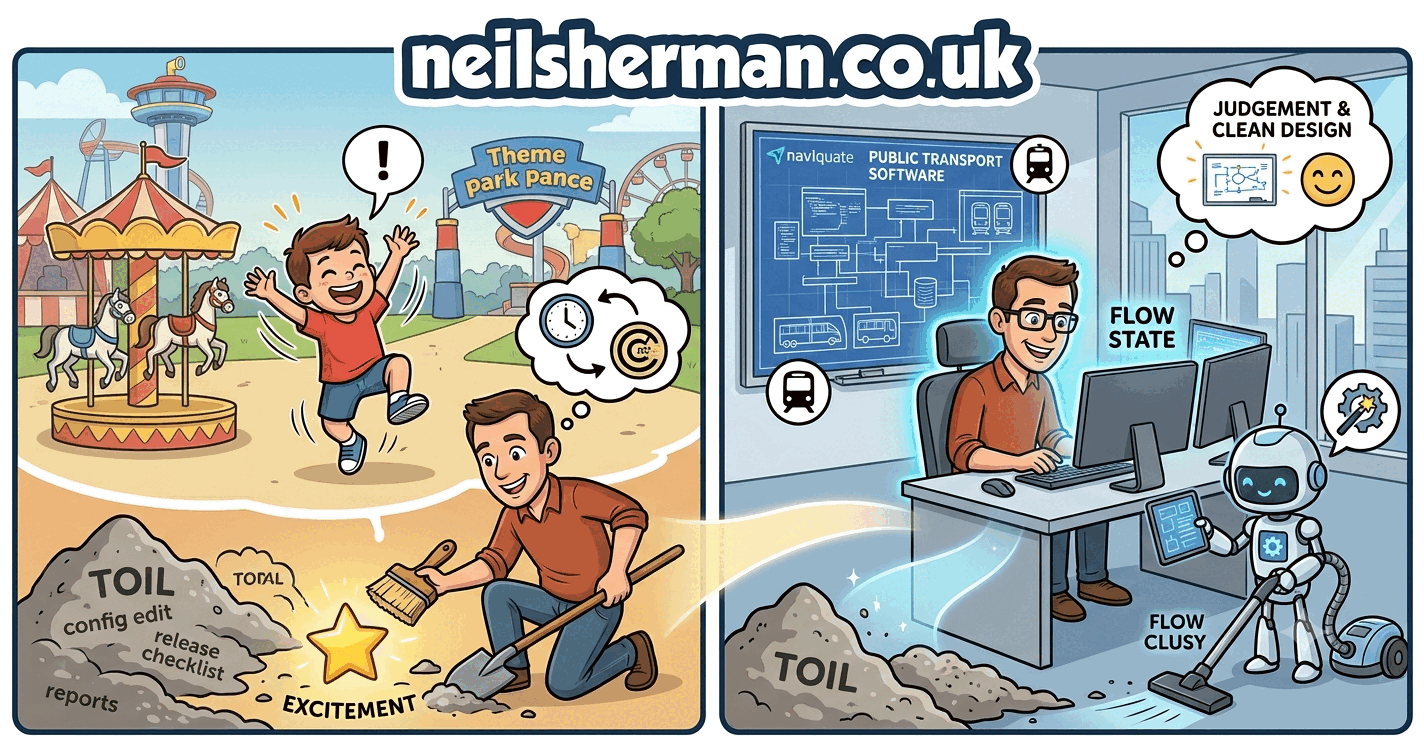
We took the children to Chessington earlier this week, and somewhere between the car park and the third overpriced ice cream, my youngest met Chase.
For those of you not currently sharing a house with a three-year-old, Chase is a police dog from the cartoon Paw Patrol, and to my son he sits somewhere between the Prime Minister and God. When Chase appeared at the World of Paw Patrol, my son did the thing small children do and the rest of us are gently discouraged from doing. He jumped up and down on the spot, both feet, for a sustained period, making a noise I have never once heard him make about anything I have cooked.
It is a pleasure to watch, that kind of excitement, because it comes with no brakes at all. The adult in me had clocked the actor’s shift pattern and the licensing deal within about four seconds. None of that reached my son. His hero had appeared in front of him, and his whole body agreed at once.
On the drive home, with both children asleep and the cat presumably redecorating the sofa in our absence, I found myself thinking about the last time I felt anything close to that about my own work.
I am an architect, which in software means I spend my days deciding how large systems fit together, and I have been doing some version of it for twenty-five years. That is long enough to have watched the excitement come and go, and to have worried, once or twice, that it had packed up and left for good.
The work never stopped mattering. What changed was how much other stuff collected on top of it. Google’s site reliability engineers have a precise word for that stuff. They call it toil, and they define it as the manual, repetitive, automatable work that keeps a service running without ever making it better, and that grows in direct proportion to the thing you have built.
Toil is the tax you pay for having made something people use. It is the config you hand-edit for the fourth time this month, the release checklist you have followed so often you could recite it under anaesthetic, and a Friday report you still assemble by hand because doing it properly was always next quarter’s job.
It is all silt, the stuff that settles around the work, and silt is patient. Give it a few years and it will slowly bury the thing that made you want the job in the first place, which for me is designing something clean and then watching a lot of people rely on it without ever having to think about it. The excitement is still down there. Most days you have to shift a fair amount of sediment to reach it.
The current mood about AI in this profession is not a hundred miles off a funeral. The tools can write code now, quite a lot of it and quite fast, and one reading of that says the craft is finished and we are all busy training our own replacements.
I read it almost exactly the other way, and the toil framing is why.
The work the machine is boringly, reliably good at is the silt. It is good at the config nobody wanted to hand-edit, the fourth near-identical service, the test scaffolding and the migration scripts and the glue that holds one system to the next. The machine is perfectly content doing the repetitive, automatable, low-judgement work, which happens to be the exact definition of the stuff that was burying the good bit.
When writing the code gets cheap, the value moves to the judgement around it: knowing what to build, what good looks like, and which of the machine’s four confident suggestions is the one that will not quietly ruin your weekend eight months from now. That judgement is the part I have always enjoyed most, and it is the part now going up in price.
This is not an abstract comfort to me. I build public transport software at navIQuate, which means the systems my team designs are used by a very large number of people who will never know we exist, on mornings when they simply need the thing to work so they can get where they are going. That is about as close as my job comes to a small boy meeting Chase. You make something well, and someone you will never meet leans on it completely, and the machinery stays out of their way.
The reason I am cheerful about all this has less to do with speed than with where the working week ends up. Google’s DORA team, who study this across a very large number of engineers, found that the developers leaning hardest on gen AI report more time in a flow state, higher job satisfaction and less burnout (Impact of Generative AI in Software Development). That flow state is the good bit under the silt. Their research is also clear that the gains land for teams who keep human judgement and solid engineering habits firmly in charge, which is the version of AI adoption I recognise and the version worth arguing for.
Meeting Chase is still very much a highlight in our house. My son brings it up at unrelated moments, days later, with the same delight he had on the spot. I keep coming back to it too, mostly because I would like the professional version of that feeling rather more often than I currently manage, and for the first time in a while the job feels like it is heading that way.
I will not be jumping up and down at the next architecture review. My colleagues have been through enough, and there are rules about that sort of thing. But if a machine wants to take the toil off my desk so I can get back to the part that once made a slightly younger me carry on like that in front of a whiteboard, it can have it. Gladly.
References
- Google, Site Reliability Engineering, Chapter 5: Eliminating Toil. https://sre.google/sre-book/eliminating-toil/
- Google DORA, Impact of Generative AI in Software Development. https://dora.dev/ai/gen-ai-report/
Views are my own and do not necessarily reflect those of my employer.