It Was Never About the How
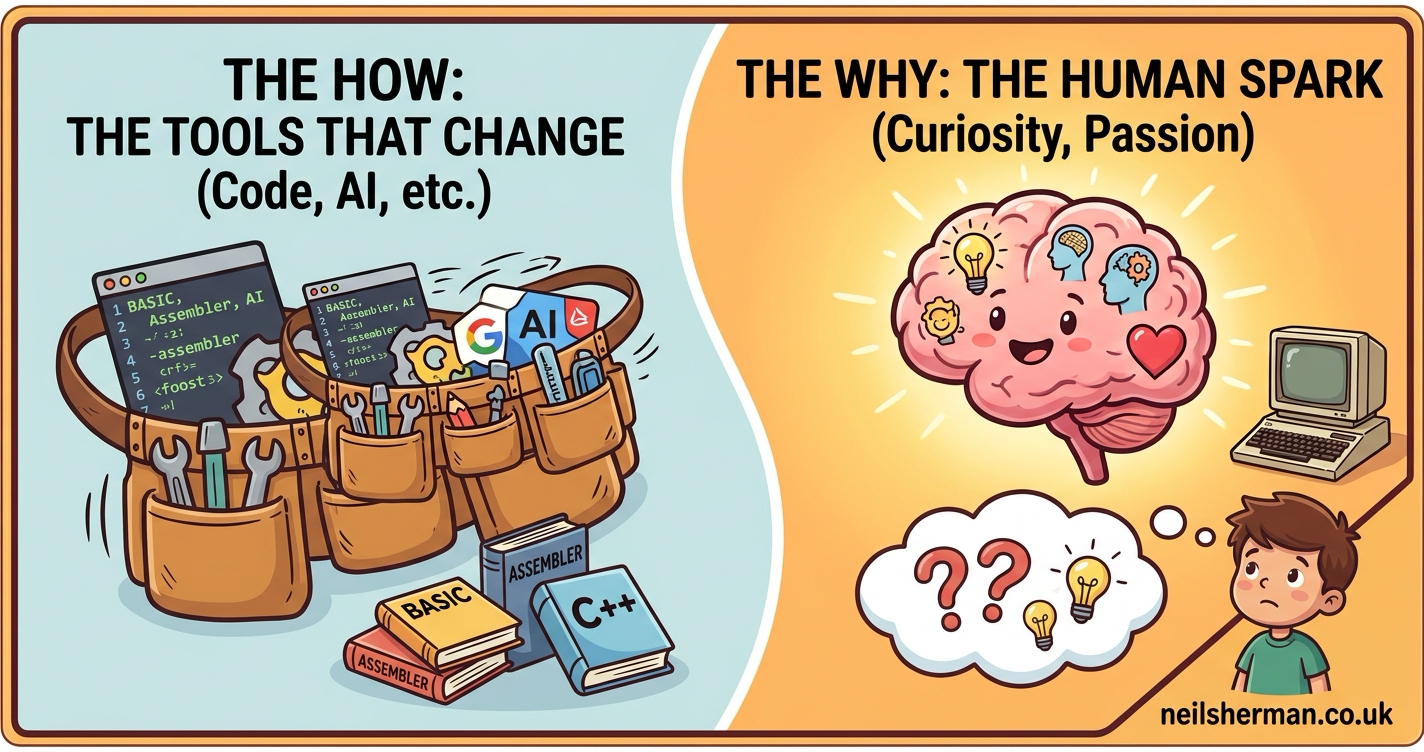
I caught myself worrying the other day, the way every parent does now. Not the everyday sort, the screen time and whether they’ll ever willingly eat a vegetable, but the bigger one sitting behind all of it. AI is going to change everything, and some quiet, unhelpful voice at the back of my head kept insisting there’d be no jobs left for my kids by the time they got there.
Then I realised I had it the wrong way round.
It was never really about the how. It was always about the why. The how is just the tool you happen to be holding at the time, and tools come and go. BASIC, assembler, whatever turns up next. The why is the thing underneath, the reason you reach for the tool at all, and that part does not move. A machine can copy the how all day long. What it can’t do is want something in the first place.
I didn’t reason my way to that. I got there by looking back at a ten year old version of me and working out what was actually driving him.
The computer that arrived second hand
When my dad brought home a BBC Micro, second hand but in good shape, I was hooked the moment it powered up. I’d never had a computer of my own before, and it was everything and more. I was never fully prised away from it again, which can’t have been much fun for anyone else. What really pulled me in was what I could make it do. My friends wanted to play the games. I wanted to build them.
Other times it had nothing to do with games, just some small problem that felt like a crisis to me and to nobody else. Our printer was an ancient dot matrix thing, and while everyone else was handing in homework off a crisp inkjet, mine came out looking like a ransom note with tractor-feed holes down both sides. So I taught it to print every line twice, a fraction offset, until the pages came out dark and almost respectable. Each sheet took roughly an ice age, but I had endless time and no idea what it was worth.
Another friend had the latest Teenage Mutant Ninja Turtles game, which of course didn’t exist for the BBC, a state of affairs I took as a personal insult. So I set about writing my own. I got as far as a genuinely decent intro screen and then wandered off, because by then I’d settled the only question I actually cared about, which was whether I could.
It went well past a hobby. The reading book I chose for myself at primary school was the BBC programmers manual, which tells you most of what you need to know about me. I’m fairly sure the adults around me were mildly concerned, and they weren’t wrong to be. But none of it ever felt like effort, and that’s the part that stuck. It wasn’t a career I chose so much as the only thing that ever really made sense to me, and that bit I didn’t learn from anyone. It was there from the start.
Every how has a shelf life
None of it began with the technology. It began with a want, and the code was only ever how I got there. I’ve been doing this for more than twenty five years now, and the industry has changed out of all recognition. Languages, platforms, whole earnest ways of working have turned up and then quietly vanished again. Each one took genuine skill, and each one was still only a how. Not one of them ever touched the why.
Curiosity was always the scarce part
For my kids the how will shift faster than it ever did for me. When I was small, the wanting was never the hard bit. Getting hold of anything to feed it was. A few library books I borrowed so often the staff must have assumed I’d lost them, a manual I’d more or less learned by heart, the odd envelope from a software company if I wrote off and waited long enough. My kids have the reverse problem. They can ask almost anything and have an answer in seconds, then keep pushing until the question sharpens. The answers I had to graft for are close to free for them now. What stays expensive, what always was, is knowing which question is worth asking and wanting it answered badly enough to chase it down. Curiosity is the part that stayed scarce.
That used to keep me awake about their future, and it doesn’t now. A model gives everyone who asks something back, and it can’t hand anyone a reason to care. What it does do is amplify, paying out in proportion to what you bring. Ask it something vague and you get something vaguely useful. Know exactly what you’re really after, and why it matters, and it takes you somewhere you couldn’t have reached alone. The clearer the why, the more it gives back. If my kids grow up asking why and wondering what comes next, they’ll be fine. If they don’t, all the answers on tap won’t add up to much, and they wouldn’t have for me either, back when my whole toolkit was a library card.
They weren’t buying me a how
I’m grateful to my mum and dad for that computer. It was money they almost certainly couldn’t spare, handed over for a child who would not stop going on about it. My dad even signed up for a college course to try to keep pace, which was either the most generous thing a parent can do or a fair indication of how insufferable I’d become on the topic. He didn’t last the course. They weren’t buying me a how. Without the faintest idea what they’d started, they were feeding a why, and all these years later it still hasn’t run dry. I don’t think I ever properly thanked them.