The Circuit Breaker Pattern: Or How I Learned to Stop Worrying and Let the Service Fail
You know that moment when your three-year-old asks “why?” for the fourteenth consecutive time and you just… stop answering? Not forever. Just long enough to preserve what remains of your sanity. You take a breath. You count to ten. Then you tentatively offer one more answer to see if the loop has broken.
Congratulations. You’ve just implemented the circuit breaker pattern.
What Actually Is It?
The circuit breaker pattern is a resilience mechanism for distributed systems. It wraps calls to external services in a monitoring object that tracks failures. When those failures hit a configured threshold, the breaker “trips” and immediately rejects subsequent requests rather than letting them pile up and wait for inevitable timeouts. After a cooling-off period, it cautiously lets a few requests through to test whether the downstream service has recovered.
The concept borrows directly from electrical engineering, where a physical circuit breaker cuts power when current exceeds safe levels. In software, Michael Nygard brought the idea into the mainstream with his 2007 book Release It! Design and Deploy Production-Ready Software. Martin Fowler then gave it a wider audience through a much-referenced blog post, and Netflix cemented it into the industry consciousness by baking it into their Hystrix library.
It’s worth noting the delightful irony that in electrical engineering, a “closed”
circuit means current is flowing, while in everyday language “closed” usually means shut.
Software adopted the electrical convention, so a closed circuit breaker means everything is
working and requests are flowing through. If that feels backwards, welcome to our industry, where we
also decided that arrays should start at zero and that null was a billion-dollar idea.
The Three States (Or: Toddler Bedtime in Three Acts)
A circuit breaker operates in three distinct states, and if you have ever put a small child to bed, you already understand all of them intuitively.
Closed (Everything Is Fine)
In the closed state, all requests pass through to the downstream service as normal. The breaker quietly tracks success and failure rates in the background, typically using either a count-based sliding window (the last N calls) or a time-based sliding window (all calls within the last N seconds). This is the equivalent of your child lying in bed, eyes closed, blanket tucked in, nightlight on. The system is healthy. You are tiptoeing away from the door. All is well.
But the breaker is counting. It always counts.
Open (Nothing Is Fine)
When failures exceed a configured threshold — maybe five consecutive errors, maybe a 50% failure rate over a sliding window — the breaker trips open. All incoming requests are immediately rejected with a fast failure or routed to a fallback response. No actual call to the downstream service is made.
This is the equivalent of the fourth time your child has appeared in the living room claiming they need water, are scared of a shadow that looks like a dinosaur, or have an urgent philosophical question about whether fish have feelings. You have stopped engaging. The circuit is open. You are returning a cached response: “Bed. Now.”
The breaker stays open for a configured timeout, typically somewhere between thirty seconds and a few minutes, giving the struggling service breathing room to recover.
Half-Open (Cautious Optimism)
After the timeout expires, the breaker enters the half-open state. It allows a small number of test requests through to probe whether the downstream service has recovered. If those requests succeed, the breaker resets to closed and normal traffic resumes. If they fail, it snaps back open and the timeout begins again.
You crack the bedroom door open. You whisper: “Are you asleep?” If silence, brilliant — the circuit closes, you pour yourself a glass of wine. If a small voice says “actually I have one more question about fish,” the circuit reopens and you retreat for another ten minutes.
Worth noting: Half-Open is only reachable from Open. There’s no direct Closed-to-Half-Open transition. It exists purely as a recovery probe — a state the breaker enters only after it has already tripped and is cautiously testing whether the downstream service is healthy again.
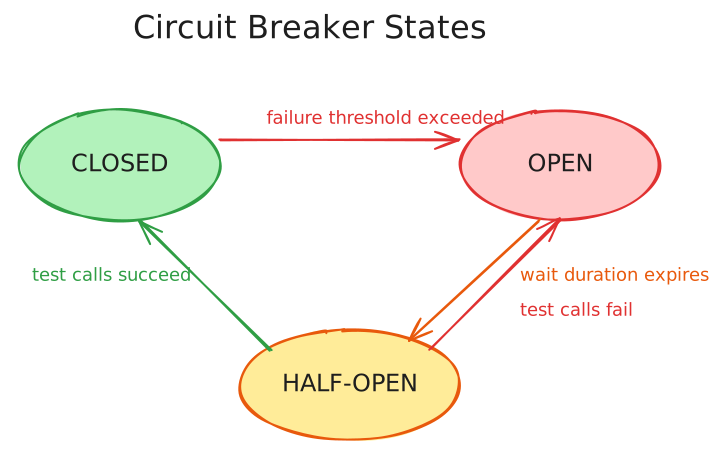
In pseudocode, the state machine looks roughly like this:
if (state == CLOSED && failureRate > threshold)
    → transition to OPEN

if (state == OPEN && timeSinceTripped > waitDuration)
    → transition to HALF_OPEN

if (state == HALF_OPEN && testCallsSucceeded)
    → transition to CLOSED

if (state == HALF_OPEN && testCallsFailed)
    → transition to OPEN
Simple enough. But like bedtime, the devil is in the configuration.
Where Did This Pattern Come From and Who Uses It?
The pattern really found its moment during the microservices era. The fundamental problem it addresses — cascading failure across distributed dependencies — became drastically more common as monoliths gave way to dozens or hundreds of independently deployed services. Nygard had formalised the idea in 2007, but it took the industry a few years of painful production incidents to collectively realise he was right.
Netflix was arguably the most high-profile early adopter. They built Hystrix, an open-source library that wrapped every inter-service call in their architecture with circuit-breaking logic. At the scale Netflix operates — with over a thousand microservices — a single slow dependency could consume all available threads across multiple upstream services and bring down the entire platform. Hystrix became the industry standard for several years.
However, Netflix moved Hystrix into maintenance mode in November 2018, with the final release being
version 1.5.18. They cited a shift toward adaptive implementations that respond to real-time performance
rather than preconfigured thresholds. The torch passed to Resilience4j, a lightweight library inspired
by Hystrix but built on functional programming principles. Where Hystrix required wrapping calls in
HystrixCommand objects and pulled in a chain of transitive dependencies (Archaius, Guava,
Apache Commons), Resilience4j uses higher-order functions and decorators with a minimal dependency
footprint (Vavr being the main one, though later versions have reduced even that). Spring now officially
recommends Resilience4j for new projects, and the Spring Cloud Hystrix project is formally
deprecated.
The pattern is now implemented across virtually every major language and platform. There’s a library reference table near the end of this post if you want the specifics, but the short version is: whatever stack you’re on, somebody has already built this for you. Don’t roll your own.
A Concrete Example
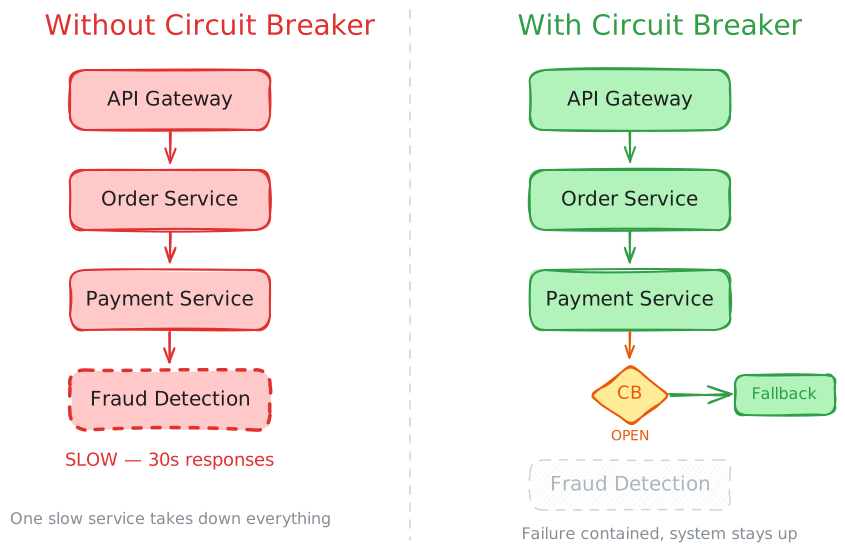
Let’s say you run an e-commerce platform. Your Order Service calls a Payment Service, which in turn calls a Fraud Detection service. The Fraud Detection service develops a memory leak and starts responding in 30 seconds instead of 200 milliseconds. Note: it hasn’t crashed. It’s just slow. And slow is actually worse than dead, because a dead service returns errors immediately.
This is the software equivalent of a child who isn’t throwing a full tantrum but is whining at a frequency specifically calibrated to erode your will to live. You can’t point to a single catastrophic event. Everything is just… gradually falling apart.
Without a circuit breaker, here is what happens. The Payment Service threads start piling up waiting for Fraud Detection responses. The Payment Service thread pool fills. The Order Service threads start piling up waiting for Payment Service responses. The Order Service thread pool fills. Your API Gateway starts timing out. Your customers see a blank screen. Your on-call engineer’s phone starts buzzing at 2am.
One slow service just took down four services in about sixty seconds.
With a circuit breaker on the Payment-to-Fraud call, the breaker would detect the rising failure rate, trip open after a handful of timeouts, and start returning a fallback response immediately. Maybe the fallback skips fraud checking for low-value orders, or queues the fraud check for later, or returns a cached risk score. The point is that the failure is contained. Payment Service stays healthy. Order Service stays healthy. Customers keep buying things. Your on-call engineer sleeps through the night.
Show Me the Code
Let’s take that same fraud detection scenario and make it real. We’ll use Resilience4j, which is the library you should be reaching for in 2025/2026 unless you have a very specific reason not to. Version 2.x requires Java 17+, and version 3.x requires Java 21+.
Approach 1: Spring Boot Annotations (The Easy Way)
First, add the dependencies. If you’re on Spring Boot 3:
<dependency>
    <groupId>io.github.resilience4j</groupId>
    <artifactId>resilience4j-spring-boot3</artifactId>
    <version>2.2.0</version>
</dependency>
<dependency>
    <groupId>org.springframework.boot</groupId>
    <artifactId>spring-boot-starter-aop</artifactId>
</dependency>
<dependency>
    <groupId>org.springframework.boot</groupId>
    <artifactId>spring-boot-starter-actuator</artifactId>
</dependency>
Configure the breaker in application.yml:
resilience4j:
  circuitbreaker:
    instances:
      fraudService:
        sliding-window-type: COUNT_BASED
        sliding-window-size: 10        # Track the last 10 calls
        minimum-number-of-calls: 5     # Don't evaluate until we have 5 calls
        failure-rate-threshold: 50     # Trip if 50% of calls fail
        wait-duration-in-open-state: 30s
        permitted-number-of-calls-in-half-open-state: 3
        slow-call-rate-threshold: 80   # Also trip if 80% of calls are slow
        slow-call-duration-threshold: 2s
        automatic-transition-from-open-to-half-open-enabled: true
That slow-call-rate-threshold config is worth highlighting. It lets the breaker trip not
just on outright failures but on calls that succeed yet take too long. Remember: slow is worse than
dead. This is the “my child isn’t technically misbehaving but has asked me to re-read
the same page of the same book for the ninth time” scenario. Technically compliant, spiritually
exhausting.
Now annotate your service method:
@Service
public class FraudCheckService {

    private final RestClient restClient;

    public FraudCheckService(RestClient.Builder builder) {
        this.restClient = builder
            .baseUrl("https://fraud-api.internal")
            .build();
    }

    @CircuitBreaker(name = "fraudService", fallbackMethod = "fallbackFraudCheck")
    public FraudResult checkTransaction(Transaction txn) {
        return restClient.post()
            .uri("/api/v1/check")
            .body(txn)
            .retrieve()
            .body(FraudResult.class);
    }

    /**
     * Fallback when the circuit is open or the call fails.
     * The method signature must match the original, plus a Throwable parameter.
     */
    private FraudResult fallbackFraudCheck(Transaction txn, Throwable t) {
        log.warn("Fraud check unavailable, applying fallback for txn {}. Reason: {}",
                 txn.getId(), t.getMessage());

        // Low-value transactions get a pass; high-value ones get queued for review
        if (txn.getAmount().compareTo(new BigDecimal("100.00")) < 0) {
            return FraudResult.approved("Fallback: low-value auto-approve");
        }
        return FraudResult.pendingReview("Fallback: queued for manual review");
    }
}
A few things to note here. The fallback method must have the same return type and parameters as the
original, with an additional Throwable parameter at the end. Resilience4j uses Spring AOP
proxies under the hood, so the annotated method must be on a Spring-managed bean and must not be called
from within the same class (the classic proxy trap that catches everyone at least once, usually at 5pm
on a Friday).
Approach 2: Programmatic API (More Control)
When you need finer-grained control, or you’re not using Spring, Resilience4j’s programmatic API is clean and composable:
public class PaymentGateway {

    private final CircuitBreaker circuitBreaker;
    private final Retry retry;
    private final FraudClient fraudClient;

    public PaymentGateway(FraudClient fraudClient) {
        this.fraudClient = fraudClient;

        // Build a custom circuit breaker config
        CircuitBreakerConfig cbConfig = CircuitBreakerConfig.custom()
            .failureRateThreshold(50)
            .slowCallRateThreshold(80)
            .slowCallDurationThreshold(Duration.ofSeconds(2))
            .waitDurationInOpenState(Duration.ofSeconds(30))
            .slidingWindowType(SlidingWindowType.COUNT_BASED)
            .slidingWindowSize(10)
            .minimumNumberOfCalls(5)
            .permittedNumberOfCallsInHalfOpenState(3)
            .recordExceptions(IOException.class, TimeoutException.class)
            .ignoreExceptions(BusinessValidationException.class)
            .build();

        this.circuitBreaker = CircuitBreakerRegistry.of(cbConfig)
            .circuitBreaker("fraudService");

        // Wire up retry: 3 attempts with exponential backoff
        RetryConfig retryConfig = RetryConfig.custom()
            .maxAttempts(3)
            .waitDuration(Duration.ofMillis(500))
            .enableExponentialBackoff()
            .retryExceptions(IOException.class, TimeoutException.class)
            .build();

        this.retry = RetryRegistry.of(retryConfig).retry("fraudService");
    }

    public FraudResult checkFraud(Transaction txn) {
        // Compose: CircuitBreaker wraps Retry wraps the actual call
        Supplier<FraudResult> decoratedCall = Decorators
            .ofSupplier(() -> fraudClient.check(txn))
            .withRetry(retry)
            .withCircuitBreaker(circuitBreaker)
            .decorate();

        return Try.ofSupplier(decoratedCall)
            .recover(CallNotPermittedException.class,
                     e -> FraudResult.pendingReview("Circuit open"))
            .recover(IOException.class,
                     e -> FraudResult.approved("Fallback: low-risk default"))
            .get();
    }
}
Notice the recordExceptions and ignoreExceptions configuration. This is
important and often overlooked. Not every exception should trip the breaker. A
BusinessValidationException (say, an invalid card number) is the service working correctly
and telling you about bad input. You don’t want those counting toward your failure rate. Only
infrastructure-level failures like IOException and TimeoutException should
count. Getting this distinction wrong is a classic source of breakers tripping when they
shouldn’t. It’s like grounding your child for saying “I don’t like
broccoli” when the real issue was them throwing the broccoli at the dog.
Approach 3: Stacking Multiple Resilience Patterns
One of Resilience4j’s best features is the Decorators builder, which lets you
compose multiple patterns into a single pipeline. The default execution order when using annotations
is:
Retry ( CircuitBreaker ( RateLimiter ( TimeLimiter ( Bulkhead ( Function ) ) ) ) )Bulkhead executes first (innermost), retry executes last (outermost). This order is configurable via Spring properties if you need to change it. Here’s a production-style configuration that combines the lot:
resilience4j:
  circuitbreaker:
    instances:
      paymentService:
        sliding-window-size: 10
        failure-rate-threshold: 50
        wait-duration-in-open-state: 30s
        permitted-number-of-calls-in-half-open-state: 3
        minimum-number-of-calls: 5

  retry:
    instances:
      paymentService:
        max-attempts: 3
        wait-duration: 500ms
        enable-exponential-backoff: true
        exponential-backoff-multiplier: 2
        retry-exceptions:
          - java.io.IOException
          - java.util.concurrent.TimeoutException
        ignore-exceptions:
          - com.example.BusinessValidationException

  bulkhead:
    instances:
      paymentService:
        max-concurrent-calls: 25

  timelimiter:
    instances:
      paymentService:
        timeout-duration: 3s
        cancel-running-future: true
And in the service class, you just stack the annotations:
@Service
public class PaymentService {

    @CircuitBreaker(name = "paymentService", fallbackMethod = "paymentFallback")
    @Retry(name = "paymentService")
    @Bulkhead(name = "paymentService")
    @TimeLimiter(name = "paymentService")
    public CompletableFuture<PaymentResult> processPayment(PaymentRequest req) {
        return CompletableFuture.supplyAsync(() ->
            paymentClient.charge(req)
        );
    }

    private CompletableFuture<PaymentResult> paymentFallback(
            PaymentRequest req, Throwable t) {
        log.error("Payment failed for order {}: {}", req.getOrderId(), t.getMessage());
        return CompletableFuture.completedFuture(
            PaymentResult.deferred("Payment queued for retry")
        );
    }
}
Note the CompletableFuture return type. When using @TimeLimiter, your method
must return a CompletableFuture or a reactive type, because the time limiter needs to be
able to cancel the operation if it exceeds the configured duration. This catches people out. Synchronous
return types won’t work with @TimeLimiter, and the error message you get
isn’t always helpful. Ask me how I know.
One subtlety worth flagging: with the default decorator order, retry sits outside the circuit breaker. That means each individual retry attempt that fails counts as a separate failure toward the breaker’s threshold. With 3 retry attempts and a sliding window of 10, just two failed requests (producing 6 total failed attempts including retries) could be enough to trip the breaker. This is usually what you want, because those retries represent real load on the downstream service. But if it surprises you during testing, now you know why.
Monitoring: Because Flying Blind Is How You Crash
Resilience4j integrates with Micrometer out of the box, which means your circuit breaker metrics flow straight into whatever monitoring stack you’re already using (Prometheus, Grafana, Datadog, whatever). Add the micrometer dependency:
<dependency>
    <groupId>io.github.resilience4j</groupId>
    <artifactId>resilience4j-micrometer</artifactId>
</dependency>
The key metrics to watch:
resilience4j_circuitbreaker_state              # Current state (0=closed, 1=open, 2=half-open)
resilience4j_circuitbreaker_calls_total        # Total calls by outcome
resilience4j_circuitbreaker_failure_rate       # Current failure rate percentage
resilience4j_circuitbreaker_slow_call_rate     # Current slow call rate
If you’re using Spring Boot Actuator, these are exposed automatically at
/actuator/metrics. Set up alerts on state transitions. A breaker that trips occasionally
and recovers is healthy. A breaker that’s been open for three hours while nobody noticed is a
horror story waiting to happen. It’s the monitoring equivalent of realising your toddler has
been “suspiciously quiet” for twenty minutes.
The Pros
Prevents cascading failures. This is the headliner, and you’ve already seen why in the e-commerce example above. But it’s worth saying plainly: in my experience, distributed systems that lack circuit breakers inevitably have an incident where one unhealthy service drags down three or four others. It’s not a question of if, it’s a question of how early on a Saturday morning.
Fails fast. Rather than tying up threads and connections waiting for doomed requests to timeout, the breaker returns immediately. Your users get a degraded response in 5 milliseconds instead of staring at a spinner for 30 seconds. Degraded but fast beats perfect but frozen.
Self-healing. The half-open state means the system automatically probes for recovery. No human intervention needed. The breaker manages its own lifecycle. I wish I could say the same about the state machine governing my children’s bedtime, but that one requires constant manual resets.
Gives downstream services time to recover. By cutting off the flood of requests, you remove the additional load that was making the problem worse. Sometimes the most helpful thing you can do is stop asking. This is also excellent parenting advice.
Observable by design. Modern implementations like Resilience4j emit rich metrics out of the box. When a breaker trips, you know exactly when, why, and for how long. That kind of visibility across every inter-service dependency is genuinely transformative for operational confidence.
The Cons
Added complexity. Every circuit breaker introduces configuration decisions: failure thresholds, timeout durations, sliding window sizes, what counts as a failure versus a legitimate error. Get these wrong and you either trip too aggressively (rejecting requests when things are merely a bit slow) or too cautiously (the breaker never activates when it should). I’ve seen teams spend more time debugging misconfigured breakers than the original failures would have caused. It’s like buying an elaborate baby monitor with seventeen sensors and then spending every evening troubleshooting false alarms instead of watching telly.
Fallback design is hard. The breaker is only as useful as your fallback strategy. Returning a generic “service unavailable” error is easy. Returning a genuinely useful degraded response that still makes sense from a business perspective? That takes real thought and careful design. What does your product do when the recommendation engine is down? Show no recommendations? Show stale ones? Show random ones and pretend it’s a “surprise picks” feature? (I’ve seen that last one in production. It was not intentional.) The best fallback strategies are invisible to the end user. The worst ones are a raw JSON stack trace on a 500 page.
Testing is non-trivial. You need to simulate failure conditions in a realistic way to validate that your breaker behaves correctly. This means chaos engineering, fault injection, and load testing, none of which are trivial to set up or maintain. Tools like Chaos Monkey (also from Netflix, naturally) and Gremlin can help, but they bring their own learning curve.
Can mask real problems. If your breaker is silently swallowing failures and returning fallback responses, and nobody is watching the dashboards, you might not realise that a downstream service has been unhealthy for hours. Observability is not optional. I cannot stress this enough.
State management in distributed systems. If you have ten instances of a service each
running their own circuit breaker, they each maintain independent state. One instance might have its
breaker open while another’s is closed. Resilience4j’s CircuitBreakerRegistry
is in-memory and per-JVM. This is usually acceptable and by design (each instance sees its own view of
the downstream service’s health), but it can lead to inconsistent behaviour that confuses people
during incident reviews. For shared state, you’d need to look at infrastructure-level solutions
like a service mesh.
Companion Patterns
The circuit breaker rarely operates in isolation. It’s typically deployed alongside several complementary resilience patterns. In fact, retries without a circuit breaker in a microservices landscape is widely considered an anti-pattern, because uncontrolled retries during an outage just amplify the problem. It’s the equivalent of your whole family independently texting “are we nearly there yet?” on a car journey that’s clearly stuck on the M5.
Retry with Backoff
Before the breaker trips, you usually want to retry failed calls a few times, ideally with exponential backoff and jitter to avoid thundering herd problems. The typical ordering is: the circuit breaker wraps the retry logic, so retries happen inside the breaker’s monitoring. If retries exhaust themselves, the breaker counts it as a failure. Resilience4j handles this composition natively, and the decorator order matters.
Bulkhead
Named after the watertight compartments in a ship’s hull, the bulkhead pattern isolates different service calls into separate thread pools or semaphores. If your Payment Service calls both Fraud Detection and Currency Conversion, bulkheading ensures that a thread pool exhaustion from Fraud Detection doesn’t starve Currency Conversion of resources. Think of it as giving each child their own bedroom so that when one has a meltdown at 3am, the other can still sleep.
Resilience4j offers two flavours: semaphore-based (limits concurrent calls, lower overhead) and thread-pool-based (fully isolates execution threads). The semaphore approach is the default and suits most cases.
Timeout (TimeLimiter)
Wraps each individual call with a hard time limit. The circuit breaker tracks whether calls succeed or fail, but the timeout is what prevents any single call from hanging indefinitely. Without a timeout, a breaker configured for count-based failures could sit there watching threads block for 30 seconds each before it has enough data points to trip. That’s potentially five minutes of accumulated thread starvation before the breaker even wakes up. Always pair your circuit breaker with a sensible timeout. They’re like seatbelts and airbags: each useful on its own, but the combination is where the real safety lives.
Rate Limiting
Controls the rate at which requests are made to a downstream service. Where a circuit breaker reacts to failure, a rate limiter proactively prevents overload before failure occurs. Think of the circuit breaker as the fire extinguisher and the rate limiter as the “don’t leave candles unattended” sign. They solve related but different problems and work well together.
Fallback / Graceful Degradation
You’ve seen fallback strategies throughout the code examples above, so I won’t belabour the point. Just remember: a circuit breaker without a well-designed fallback is a fast failure instead of a slow one. That’s an improvement, but it’s not the finish line.
Service Mesh (Infrastructure-Level Circuit Breaking)
Tools like Istio, Linkerd, and Envoy can implement circuit-breaking at the proxy level, which means your application code doesn’t need to know about it at all. This is a compelling option if you want to apply consistent resilience policies across a large fleet of services without modifying each one individually. The tradeoff is that you lose application-level awareness and the ability to implement business-logic-aware fallbacks. A service mesh can trip a breaker, but it can’t return your user a sensible cached recommendation.
Alternatives and Tradeoffs
The circuit breaker is the most well-known resilience pattern but it’s not always the right tool.
Retry-only approaches work fine when failures are genuinely transient — a blip lasting milliseconds, not a sustained outage. If the downstream service recovers before your retries exhaust, you never need the breaker at all. But retry-only can make things catastrophically worse during a real outage, because every caller is now hammering the sick service with multiple attempts. Three services each retrying three times means your dying service just received nine times the traffic that was already killing it. Helpful.
Adaptive concurrency limits (the direction Netflix themselves moved toward) dynamically adjust the number of concurrent requests allowed based on observed latency and throughput, rather than relying on preconfigured thresholds. Netflix’s concurrency-limits library on GitHub is worth a look if you find yourself constantly tweaking static thresholds. It’s more sophisticated but harder to reason about and debug.
Queue-based load levelling decouples the caller from the callee entirely by putting requests onto a message queue. The downstream service processes them at its own pace. This changes the communication model from synchronous to asynchronous, which is a much bigger architectural decision, but it eliminates the failure coupling that circuit breakers are designed to manage. If you can tolerate eventual consistency and don’t need a synchronous response, this is often the more robust long-term architecture.
Service mesh with outlier detection (Istio/Envoy) can eject unhealthy endpoints from a load balancing pool based on observed error rates, which achieves a similar effect to a circuit breaker but at the infrastructure layer. The advantage is consistency across all services without code changes. The disadvantage is that you’re now debugging YAML. So much YAML.
Library Quick Reference
| Language | Library | Notes |
|---|---|---|
| Java/Kotlin | Resilience4j | The standard. v2 needs Java 17+, v3 needs Java 21+. Modular, functional, Spring Boot integration. |
| Java | Hystrix | Deprecated since Nov 2018. Don’t start new projects with it. If you’re still on it, migrate. |
| Java | Sentinel | Alibaba’s alternative. Strong flow control and real-time monitoring dashboard. |
| .NET | Polly | Mature, fluent API. First-class integration with IHttpClientFactory. |
| Node.js | opossum | Lightweight, Promise-native. Good TypeScript support. |
| Go | sony/gobreaker | Simple, well-tested. The Go community’s default choice. |
| Python | pybreaker | Straightforward, works with any Python web framework. |
| Infra | Istio / Envoy | Proxy-level circuit breaking. No code changes required. Limited fallback flexibility. |
Final Thoughts
The circuit breaker pattern is one of those ideas that feels obvious once you understand it, which is usually a sign of genuinely good design. It’s a direct translation of a real-world safety mechanism into software, and it solves a problem that will absolutely bite you in production if you ignore it.
Like most patterns, though, it’s not a silver bullet. It requires careful configuration, meaningful fallbacks, and solid observability to deliver on its promise. Slapping a circuit breaker on every outbound call without thinking through the failure modes is the resilience equivalent of buying a smoke alarm and then removing the batteries because the beeping is annoying.
Get it right, though, and it’s one of the most effective tools you have for building systems that degrade gracefully instead of catastrophically. And honestly, that’s a life skill that extends well beyond software.
Ask any parent.